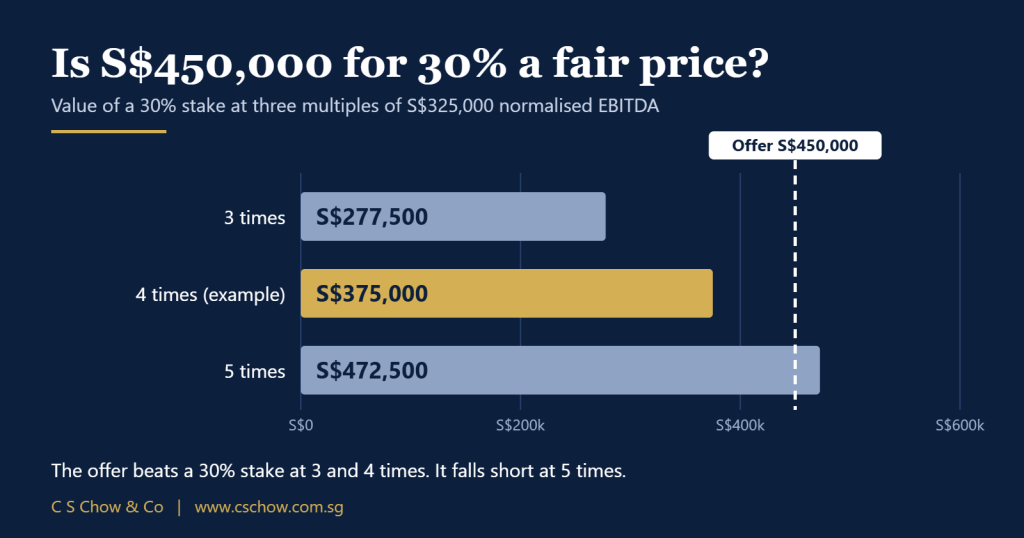
An investor offers you S$450,000 for 30% of your company. Maths says your whole company is worth S$1.5 million. Is the offer fair? You cannot answer from the offer alone. You need a value first.
Your company is worth neither the net assets on your balance sheet nor a multiple you heard at a networking dinner. A buyer pays for the profit taken over, the risk of earning the same profit again, and the cash and debt sitting in the company.
Three ways to value a company
- Income approach. You value the profit the company earns, usually as a multiple of normalised earnings or as discounted future cash flows.
- Market approach. You compare with sales of similar businesses and adjust for size and risk.
- Asset approach. You add up assets at fair value and subtract liabilities. This suits a property holding company or a loss-making company better than a healthy service business.
Most small operating companies lead with the income approach and use the market approach as a cross-check.
A worked example
Your engineering services company reports profit before tax of S$300,000, with interest of S$20,000 and depreciation of S$30,000.
- EBITDA: 300,000 + 20,000 + 30,000 = 350,000
- Add back your family car and personal travel booked in the company: 40,000
- Add back a one-off legal dispute: 25,000
- Deduct the cost of a general manager to replace you. You draw S$60,000 and take the rest as dividends. A hired manager costs S$150,000 with CPF, so you deduct 90,000.
- Normalised EBITDA: 350,000 + 40,000 + 25,000 – 90,000 = 325,000
A buyer prices this figure, not your reported profit. Apply a multiple of 4 times, chosen here for illustration. A valuer sets the real multiple from market evidence and your risk profile.
- Enterprise value: 325,000 x 4 = 1,300,000
- Add cash of 180,000 and deduct the bank loan of 230,000
- Equity value: 1,300,000 + 180,000 – 230,000 = 1,250,000
Thirty percent of S$1,250,000 is S$375,000. The offer of S$450,000 sits S$75,000 above this figure. A 30% minority stake normally sells at a discount to its share of the whole, so the gap widens in your favour.
The multiple does the heavy lifting. At 3 times, equity value falls to S$925,000. At 5 times, equity value rises to S$1,575,000. One turn of the multiple moves your company by S$325,000. If you hold every client relationship yourself, expect a lower multiple. Long contracts and a manager who runs daily work earn a higher one.
When you need a written valuation
- You buy or sell shares, including a partner buyout
- An investor joins or you issue shares to staff
- You test goodwill for impairment or allocate a purchase price under SFRS
- A shareholder dispute, divorce or estate needs a number
- You restructure a group
A share transfer of an unlisted company pays stamp duty on the higher of the price and the net asset value of the shares. At 0.2% on S$450,000, the duty is S$900. Gains from selling shares are generally not taxed in Singapore. Check your own facts before you rely on either point.
We value businesses, shares and intangible assets. Property valuation sits outside our scope. I am an Associate Chartered Valuer and Appraiser in Singapore, and reports follow the International Valuation Standards effective 31 January 2025. Read more about our business valuation services.
Send us your last two years of accounts and your own view of the price. WhatsApp +65 9876 3553 or email henry@cschow.com.sg.
Henry Chow
Public Accountant, C S Chow & Co